I Tried to Schedule an Electrician Using an AI Agent. Here’s How It Went.
How a routine customer service exchange uncovered both the upside and the hidden risks of letting AI speak on behalf of your company and brand.

With more organizations now using or evaluating AI‑driven customer service systems, I wanted to share a recent personal experience that highlights both the promise and the pitfalls of this technology in early 2026.
A Call for Help
It was a quiet Saturday afternoon. While working on a small Ethernet project, I made one of those "old house wiring" discoveries that can make a homeowner a little nervous. That's a story for another time, but basically an electrician was needed as soon as possible.
This is a job for Angi.
Angi Spreads the Word
Angi is very effective at rapidly matching customers with local contractors. Arguably, almost too effective - within seconds of submitting my request, my phone lit up with five different texts. Parsing through this mini-avalanche of help can be a bit overwhelming.
None of these messages stood out; just basic boilerplate text messages most of us see every day. I scrolled to the second one, a message from 'Tim" (name changed), asking what services I was looking for Even though I had already explained this to Angi earlier, I replied to the text with my issue.
Nearly instantaneously, faster than a human could type, “Tim” responded with that unmistakable "happy empathy robot" tone, asking for more details.

Texting with "Tim"
What followed were a series of text messages with Tim that ran me through a standard service on-boarding script (name, address, type of home, description of the problem, etc.). Chat systems have been capable of this for a while now, but the detailed, contextual answers were noticeably more refined.
When I mentioned a detail about my electrical panel, Tim referenced it in a way that was coherent and technically plausible. Impressive. Not exactly trade school-level detail here, but still pretty solid.

Fast responses, good tone, decent personalization. Not bad so far.
"I don't have access to the scheduling system"
Because this was urgent, I asked for the earliest available appointment.
Suddenly, Tim found a task that was beyond him.

No access to scheduling system? I thought the whole purpose of this interaction was to schedule an appointment.
At least Tim admits this limitation, which I suppose is better than lying about it like some chatbots have been known to.
A few minutes later, I got a second text…from the same company…from a different number…with none of the previous context.
Suddenly I was starting the whole service request from scratch.

As a tech person, I understand that integrating chatbots with other systems is tricky.
For the business, the downside risk of getting it wrong - booking mistakes, service agents going to the wrong places, and angry customers - is very real.
But for me as a potential customer? This is just annoyance and friction.
And I had options.
So I bailed on Tim.
I hired a company who did it the "old fashioned" way with a phone call from an actual human. Within ten minutes, they called and booked me for next day service. Problem solved.
A Day Late
On Monday, Tim reached back out to me, still unaware of the parallel text thread.

I'll say one thing for Tim - they know how to take rejection in stride.

The Path Ahead
As I write this at the tail end of 2025-early 2026, generative AI for everyday tasks like customer service has clear potential. What lies ahead is the "messy middle" - that time where initial hype fades and the hard work of building a real solution begins.
Making this work requires parsing nuance, maintaining context across platforms, securing data, and integrating with tools that were never designed for conversational interfaces. On their own, none of these tasks are trivial. Put them together, and the variables multiply.
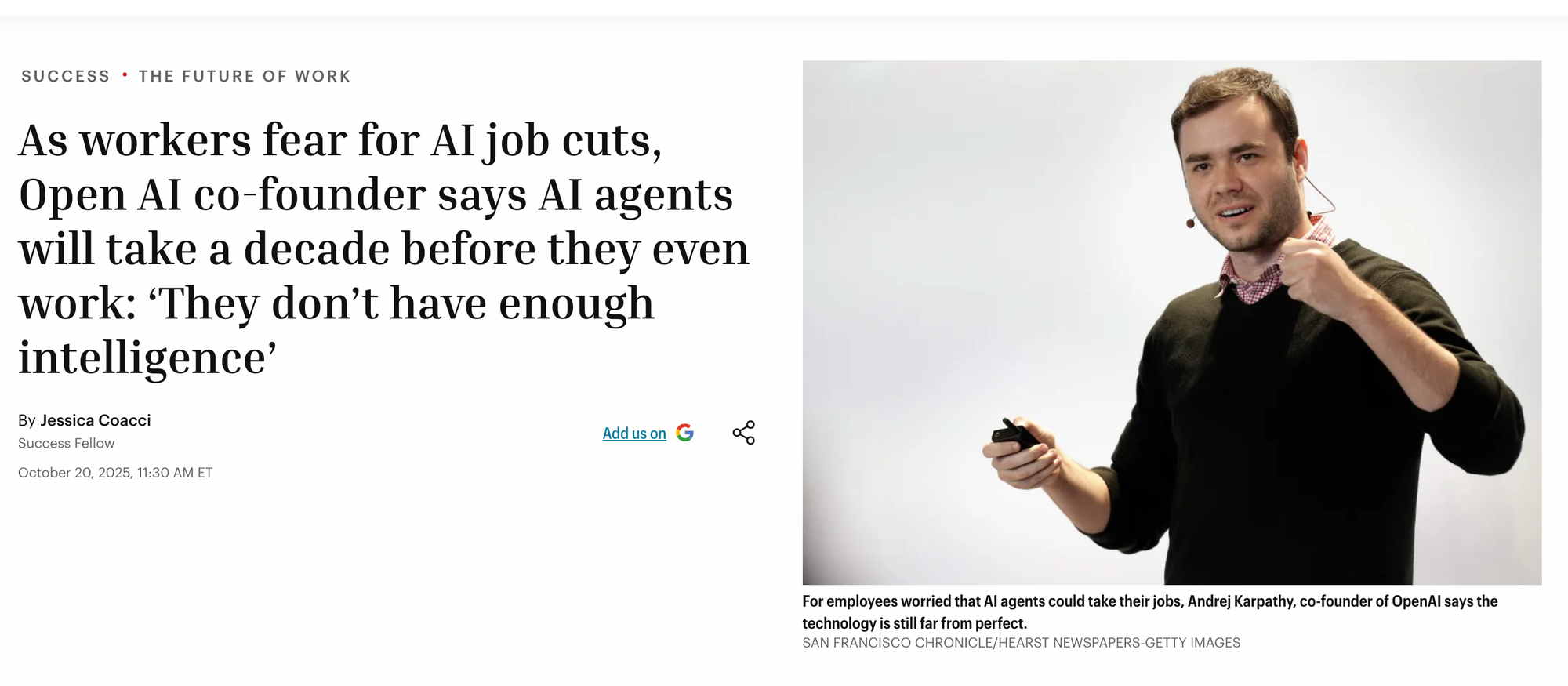
According to industry experts, it could be years before these systems work reliably.
Managing Expectations
Customer service has always required endless wells of availability, empathy, and patience. People crave attention, and a technology like AI promises nearly unlimited amounts of it. In practice, however, getting these interactions just a little wrong often frustrates a customer more than it helps them, and those impressions tend to be sticky ones.
Service failures can be devastating to brand trust. That's why Gartner recently predicted that 50% of organizations will abandon plans to reduce their customer service workforces due to AI. The risk of disappointing customers outweighs the theoretical savings.
As for this experience, I would have accepted managed expectations over perfection. If I was told up front that I was texting with an automated AI agent and told of its limitations, I doubt it would have upset me.
But then again, I probably would have simply ignored it like I do most of these systems. Giving the chatbot a name like Tim and having it pose as a human might have been the only way they could realistically get me to try using it.
If their goal was getting me to try an experimental new system to collect real-world feedback that helps them refine and improve it, they succeeded. If the goal was to get me to book an appointment, they fell short.
Giving an AI agent a human name like “Tim” creates expectations for the user. If it sounds human, responds like a person, and represents your brand, customers will judge it the way they judge every other human interaction.
That’s the real risk of AI in customer service: The moment you blur the line, the standard rises. Until the tech catches up, organizations need to think carefully where risks like this are acceptable to take.